Real Estate & Divorce Terms Explained Simply
Real Estate & Divorce Terms Explained Simply
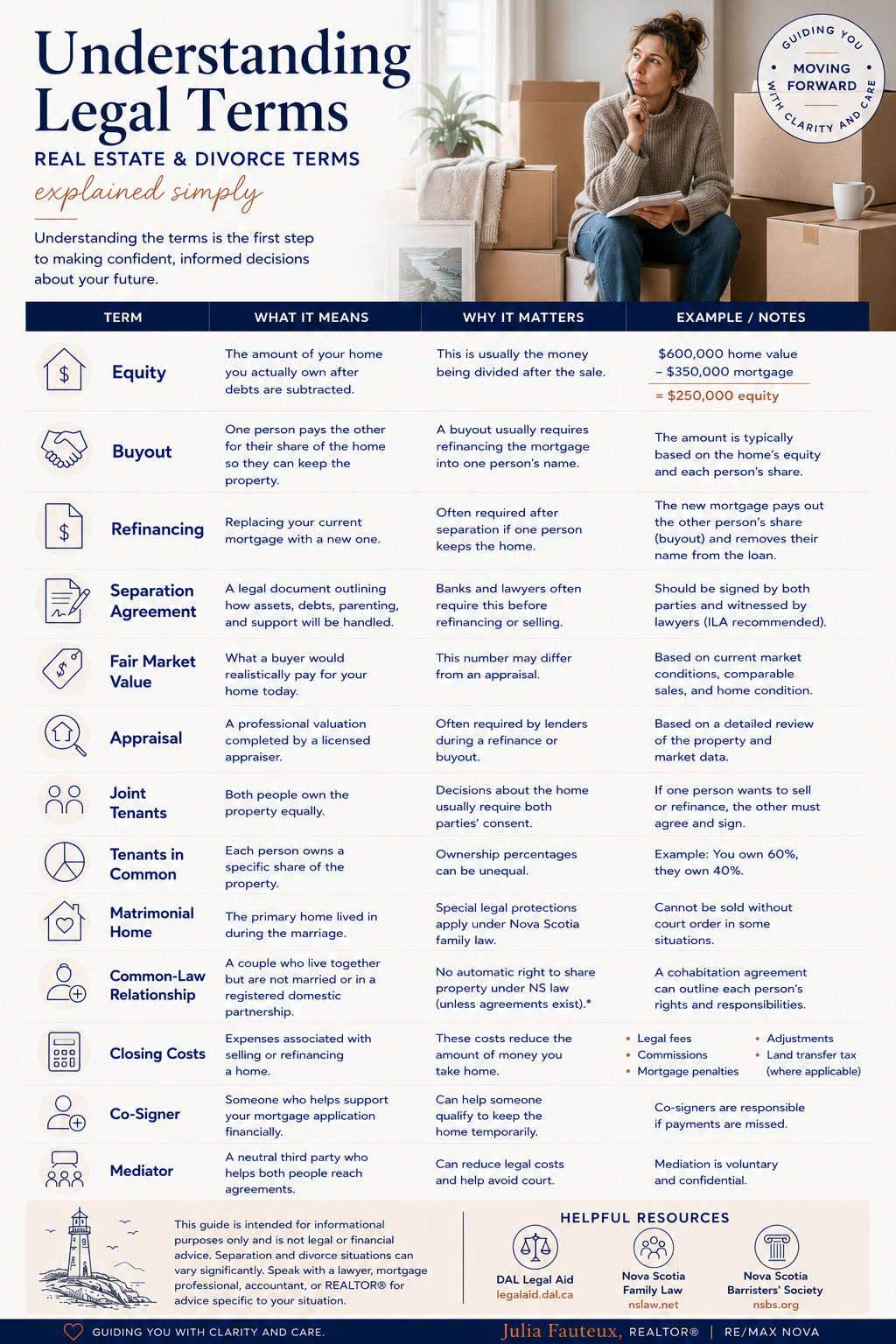
Separation and divorce often introduce people to an entirely new world of legal, financial, and real estate terminology. Terms like equity, buyout, appraisal, refinancing, matrimonial home, joint tenants, and separation agreement can quickly become part of everyday conversations during an already stressful time.
This PDF explains some of the most common divorce and real estate terms in plain language to help Nova Scotia homeowners better understand the process and make more informed decisions.
One of the most important concepts is equity — the portion of your home you own after subtracting debts like your mortgage balance. Many separation-related decisions revolve around determining how much equity exists and how it may be divided.
Another key term is buyout, where one person compensates the other for their share of the home in order to keep the property. This often requires refinancing the mortgage into one person’s sole name, which can sometimes be harder to qualify for on a single income.
The PDF also explains ownership structures like joint tenants and tenants in common, along with concepts like appraisals, fair market value, refinancing costs, mortgage penalties, and closing expenses — all of which can significantly impact the financial outcome of a separation.
The goal is to reduce confusion and help people ask better questions when speaking with lawyers, mortgage professionals, mediators, accountants, and REALTORS®.
Julia Fauteux is a Nova Scotia REALTOR® specializing in separation, divorce, relocation, and major life transitions involving real estate. These resources are for general informational purposes only and should not replace legal, financial, or professional advice specific to your situation.



 Information should be deemed reliable but not guaranteed, all representations are approximate, and individual verification is recommended. Copyright ©2017 All rights reserved.
The trademarks REALTOR®, REALTORS® and the REALTOR® logo are controlled by The Canadian Real Estate Association (CREA) and identify real estate professionals who are members of CREA. The trademarks MLS®, Multiple Listing Service® and the associated logos are owned by CREA and identify the quality of services
provided by real estate professionals who are members of CREA. Used under license.
Show More...
Information should be deemed reliable but not guaranteed, all representations are approximate, and individual verification is recommended. Copyright ©2017 All rights reserved.
The trademarks REALTOR®, REALTORS® and the REALTOR® logo are controlled by The Canadian Real Estate Association (CREA) and identify real estate professionals who are members of CREA. The trademarks MLS®, Multiple Listing Service® and the associated logos are owned by CREA and identify the quality of services
provided by real estate professionals who are members of CREA. Used under license.
Show More...
 All information deemed reliable but not guaranteed. All properties are subject to prior sale, change or withdrawal. Neither listing broker(s) or information provider(s) shall be responsible for any typographical errors, misinformation, misprints and shall be held totally harmless. Listing(s) information is provided for consumer's personal, non-commercial use and may not be used for any purpose other than to identify prospective properties consumers may be interested in purchasing. The data relating
to real estate for sale on this website comes in part from the Internet Data Exchange program of the Multiple Listing Service. Real estate listings held by brokerage firms other than REMAX Nova may be marked with the Internet Data Exchange logo and detailed information about those properties will include the name of the listing broker(s) when required by the MLS. Copyright ©2026 All rights reserved.
Last Updated: September 22, 2026 2:22 PM UTC
Show More...
All information deemed reliable but not guaranteed. All properties are subject to prior sale, change or withdrawal. Neither listing broker(s) or information provider(s) shall be responsible for any typographical errors, misinformation, misprints and shall be held totally harmless. Listing(s) information is provided for consumer's personal, non-commercial use and may not be used for any purpose other than to identify prospective properties consumers may be interested in purchasing. The data relating
to real estate for sale on this website comes in part from the Internet Data Exchange program of the Multiple Listing Service. Real estate listings held by brokerage firms other than REMAX Nova may be marked with the Internet Data Exchange logo and detailed information about those properties will include the name of the listing broker(s) when required by the MLS. Copyright ©2026 All rights reserved.
Last Updated: September 22, 2026 2:22 PM UTC
Show More...