What you need to know
What you need to know
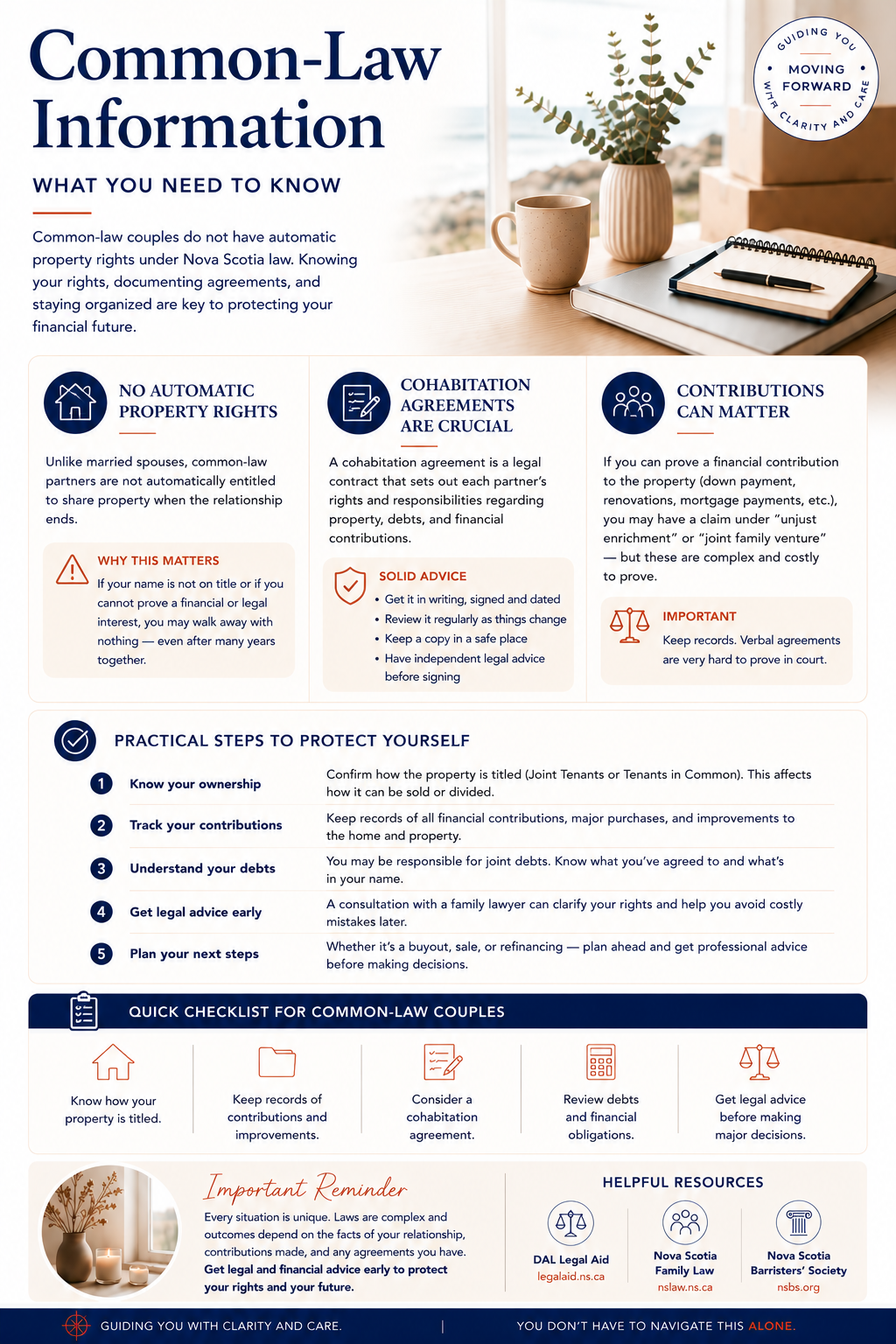
Many people separating from a common-law partner in Nova Scotia are surprised to learn that living together for years does not automatically create equal ownership rights to a home. If only one person is on title, the other person is not automatically entitled to half the property simply because they lived there or contributed to the relationship.
That does not mean they necessarily have no claim — but it often means ownership becomes a legal argument rather than an automatic right.
When common-law couples separate, some of the biggest factors become:
- whose name is on title
- whose name is on the mortgage
- who paid the down payment
- who contributed toward mortgage payments, renovations, taxes, or major expenses
- whether there were written agreements
- whether one person financially benefited unfairly from the other’s contributions
This is where legal concepts like unjust enrichment and joint family venture claims can become extremely important.
An unjust enrichment claim is essentially an argument that one person unfairly benefited from the contributions of the other. For example, if one partner paid toward renovations, mortgage payments, property taxes, childcare, or household expenses for years — but the home remained solely in the other partner’s name — they may attempt to argue they should receive compensation or an interest in the property.
Courts may examine:
- direct financial contributions
- unpaid labour that increased the home’s value
- sacrifices one partner made to support the household financially
- whether one person accumulated assets while the other carried disproportionate responsibilities
- whether there was a reasonable expectation of shared ownership
Another legal avenue sometimes pursued is a joint family venture claim. This argument attempts to establish that the couple operated financially as a shared economic partnership, even if formal ownership documents do not reflect that. Courts may look at how integrated finances were, how decisions were made, whether long-term plans were shared, and whether both parties contributed toward building wealth together.
These types of claims can become very complex, expensive, and emotionally draining. They often require detailed financial records, bank statements, proof of transfers, renovation receipts, communication records, witness evidence, and legal representation. Verbal understandings like “this was always supposed to be our house” are often difficult to prove without supporting documentation.
Property title itself can also become heavily disputed during separation. Some people pursue claims seeking:
- partial ownership of the property
- reimbursement for contributions made
- occupation rent if one partner remained in the home
- forced sale applications
- preservation orders preventing a sale or refinance
- claims against equity growth during the relationship
This becomes especially important when one person wants to sell and the other does not, or when one party believes they are entitled to a greater share of the proceeds than legal title currently reflects.
The reality is that common-law separation disputes involving real estate are often far more legally complicated than people expect. Many individuals mistakenly assume common-law relationships are treated identically to marriage under Nova Scotia law. In practice, ownership disputes frequently depend on evidence, documentation, and litigation strategy.
This guide is intended to help people better understand some of the legal and financial issues that can arise when separating from a common-law partner, particularly when real estate is involved. It is not legal advice. If ownership, equity, or financial contributions are disputed, speaking with a Nova Scotia family lawyer early is extremely important.
Julia Fauteux is a Nova Scotia REALTOR® specializing in separation, divorce, relocation, and major life transitions involving real estate. These resources are for general informational purposes only and should not replace legal, financial, or professional advice specific to your situation.


 Information should be deemed reliable but not guaranteed, all representations are approximate, and individual verification is recommended. Copyright ©2017 All rights reserved.
The trademarks REALTOR®, REALTORS® and the REALTOR® logo are controlled by The Canadian Real Estate Association (CREA) and identify real estate professionals who are members of CREA. The trademarks MLS®, Multiple Listing Service® and the associated logos are owned by CREA and identify the quality of services
provided by real estate professionals who are members of CREA. Used under license.
Show More...
Information should be deemed reliable but not guaranteed, all representations are approximate, and individual verification is recommended. Copyright ©2017 All rights reserved.
The trademarks REALTOR®, REALTORS® and the REALTOR® logo are controlled by The Canadian Real Estate Association (CREA) and identify real estate professionals who are members of CREA. The trademarks MLS®, Multiple Listing Service® and the associated logos are owned by CREA and identify the quality of services
provided by real estate professionals who are members of CREA. Used under license.
Show More...
 All information deemed reliable but not guaranteed. All properties are subject to prior sale, change or withdrawal. Neither listing broker(s) or information provider(s) shall be responsible for any typographical errors, misinformation, misprints and shall be held totally harmless. Listing(s) information is provided for consumer's personal, non-commercial use and may not be used for any purpose other than to identify prospective properties consumers may be interested in purchasing. The data relating
to real estate for sale on this website comes in part from the Internet Data Exchange program of the Multiple Listing Service. Real estate listings held by brokerage firms other than REMAX Nova may be marked with the Internet Data Exchange logo and detailed information about those properties will include the name of the listing broker(s) when required by the MLS. Copyright ©2026 All rights reserved.
Last Updated: September 21, 2026 2:14 PM UTC
Show More...
All information deemed reliable but not guaranteed. All properties are subject to prior sale, change or withdrawal. Neither listing broker(s) or information provider(s) shall be responsible for any typographical errors, misinformation, misprints and shall be held totally harmless. Listing(s) information is provided for consumer's personal, non-commercial use and may not be used for any purpose other than to identify prospective properties consumers may be interested in purchasing. The data relating
to real estate for sale on this website comes in part from the Internet Data Exchange program of the Multiple Listing Service. Real estate listings held by brokerage firms other than REMAX Nova may be marked with the Internet Data Exchange logo and detailed information about those properties will include the name of the listing broker(s) when required by the MLS. Copyright ©2026 All rights reserved.
Last Updated: September 21, 2026 2:14 PM UTC
Show More...