For many couples going through separation, this choice is a turning point. One option is to sell the home and split the money. The other is for one person to keep the house and manage the finances on their own.
At first glance, the answer might look simple.
But in real life, it usually isn’t.
That’s because this decision is about much more than just real estate. It’s connected to things like:
- Children
- Stability
- Finances
- Identity
- Comfort
- Pride
- Fear of change
- And sometimes, it’s about wanting to keep something familiar when everything else feels uncertain.
I’ve watched people struggle to keep homes they couldn’t afford for long. I’ve also seen others sell quickly, even when a buyout might have brought more stability for everyone.
The best choice depends on both emotional and financial realities, and those don’t always match up.
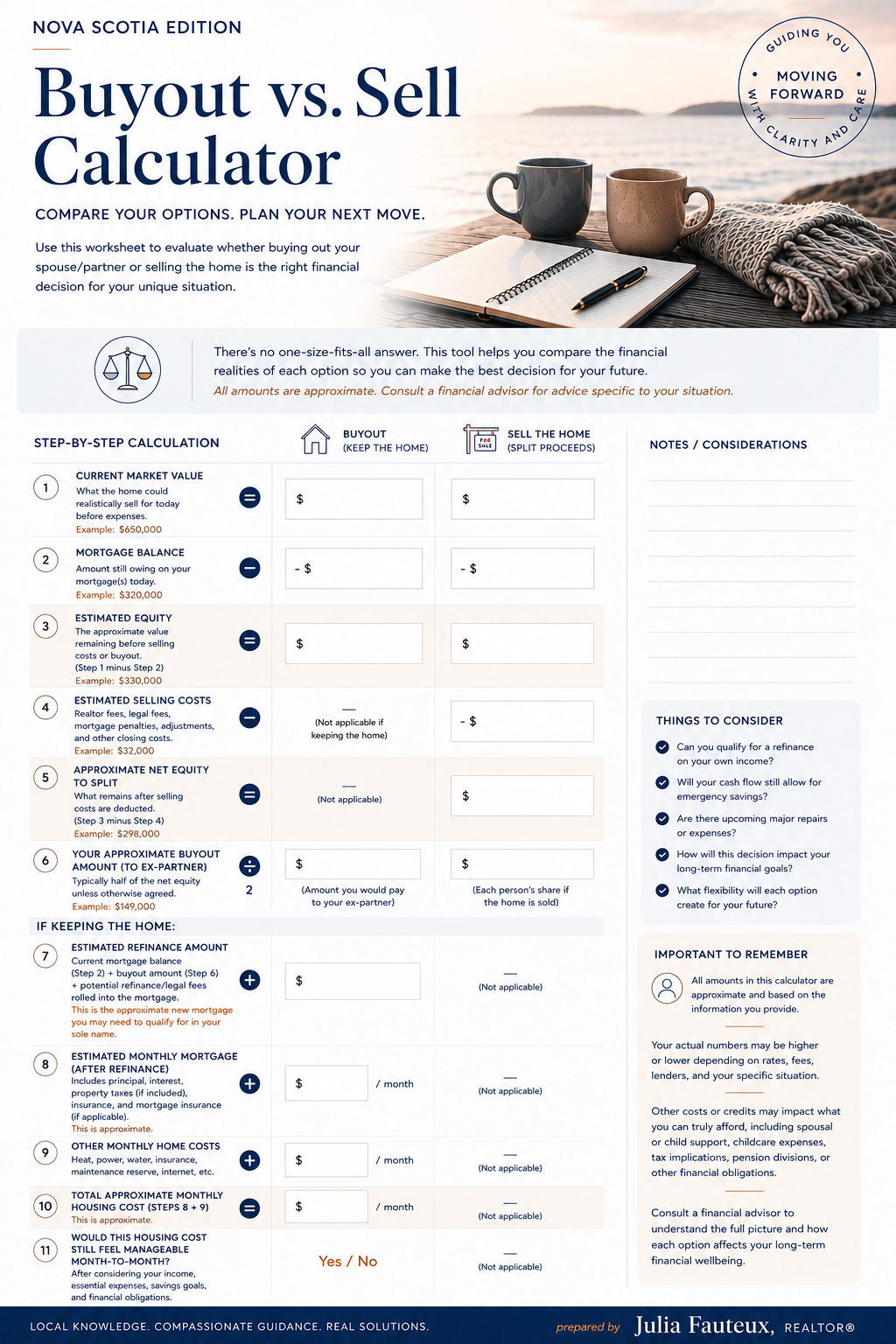
What Does a Buyout ActualA buyout usually means one spouse keeps the home and pays the other for their share of the equity.he equity.
Usually, that involves:
- Refinancing the mortgage
- Qualifying on one income
- Removing the other party from title
- Paying out an agreed-upon amount of equity
This is often where people get their first surprise:
Wanting to keep the home and actually qualifying for it are two very different things.
This is especially true with today’s interest rates.
A couple may have managed the home’s costs together, but handling:
- The mortgage
- Taxes
- Insurance
- Utilities
- Maintenance
- Childcare
- Groceries
- Life
On one income can look very different.
When Selling the Home Often Makes More Sense
Sometimes, selling the home is the simplest way to move forward financially.
Particularly when:
- Neither party can comfortably qualify alone
- There’s significant debt involved
- Tensions are high
- Repairs are being deferred
- The home has become financially stressful
- Both people need liquidity to move forward
I often tell clients this:
Sometimes, a house stops being an asset and becomes a source of stress.
And that kind of pressure can affect your decisions.
The emotional temptation is often to hold onto the home because it represents stability. But if keeping it creates constant financial strain afterward, that stability can disappear surprisingly quickly.
Selling can sometimes create:
- A financial reset
- Cleaner separation of responsibilities
- More flexibility
- Reduced conflict
- The ability for both people to move forward independently
It might not be easy emotionally, but it can be a better long-term strategy.
When Keeping the Home May Make Sense
In some cases, a buyout can work out really well.
Particularly when:
- One spouse has a high independent income
- Refinancing is realistic
- The home is deeply important for parenting stability
- The carrying costs remain manageable
- Both parties are cooperative
- The buyout amount is realistic
Sometimes, keeping the home gives children a sense of continuity during a tough time. Other times, it just makes more financial sense to keep a valuable asset rather than sell too soon.
But the important thing is being honest about the numbers. Not hopeful about the numbers. Not emotionally attached to the numbers.
Actually honest.
Because I’ve also seen people:
- Drain savings to keep a home
- Become house-poor afterward
- Defer maintenance
- Struggle with refinancing
- Feel trapped financially a year later
Ideally, your house should help you move forward, not quietly make things harder.
The Part People Often Forget: The Hidden Costs
This is often where reality hits the hardest.
When couples own a home together, they often share expenses in their minds, even if one person pays more. After separation, every cost suddenly stands out.
People often focus on:
- The mortgage payment
- The buyout amount
But forget about:
- Roof repairs
- Heat pumps
- Property taxes
- Insurance increases
- Landscaping
- Snow removal
- Appliance replacement
- Emergency repairs
- Rising utility costs
A home can feel very different financially when one person is handling all the costs alone.
What I’ve Seen Create the Most Regret
People often regret decisions made too quickly, especially when driven by:
- Fear
- Guilt
- Anger
- Panic
- Exhaustion
Separation can make every decision feel urgent.
But this is one of the biggest financial decisions most people ever face. It deserves time, planning, and honest talks with professionals.
I often encourage clients to approach this decision less emotionally and more like planning for the future.
Not:
“Can I keep the house today?”
But:
“Will this house still support my life two years from now?”
That question often changes the whole conversation.
Think of the house like a boat.
Sometimes the home is the boat that safely carries a family through a difficult transition.
Other times, people work hard to stay afloat in something that’s already struggling financially.
The hard part is that emotions can make both situations feel the same at first.
That’s why getting outside guidance is so important.
A good real estate strategy during separation isn’t about convincing anyone to sell. It’s about helping people understand:
- Their options
- Their numbers
- Their risks
- Their timelines
- And the long-term impact of whichever decision they choose
Questions Worth Asking Before Deciding
Before you decide to sell or try a buyout, it’s worth asking yourself:
- Can the home realistically be carried on one income?
- What would refinancing look like today?
- Would keeping the home reduce stress, or increase it?
- Is the attachment emotional, financial, or both?
- Would selling create more long-term flexibility?
- Are repairs or major expenses coming soon?
- What would life realistically look like 12 months after either decision?
These answers usually matter more than any emotional impulse in the moment.
Final Thoughts
There’s no single “right” answer when it comes to selling or keeping the home during separation.
The right decision is the one that:
- Protects long-term financial stability
- Creates realistic breathing room
- Supports the future you’re actually stepping into
- And allows decisions to be made strategically rather than reactively
Sometimes that means selling. Sometimes it means keeping the home.
But in most cases, the best results come when people understand the full picture before making decisions they’ll live with long after the separation is over.
If you need help figuring out what either option might look like for you, I’m always happy to have a confidential conversation.



 Information should be deemed reliable but not guaranteed, all representations are approximate, and individual verification is recommended. Copyright ©2017 All rights reserved.
The trademarks REALTOR®, REALTORS® and the REALTOR® logo are controlled by The Canadian Real Estate Association (CREA) and identify real estate professionals who are members of CREA. The trademarks MLS®, Multiple Listing Service® and the associated logos are owned by CREA and identify the quality of services
provided by real estate professionals who are members of CREA. Used under license.
Show More...
Information should be deemed reliable but not guaranteed, all representations are approximate, and individual verification is recommended. Copyright ©2017 All rights reserved.
The trademarks REALTOR®, REALTORS® and the REALTOR® logo are controlled by The Canadian Real Estate Association (CREA) and identify real estate professionals who are members of CREA. The trademarks MLS®, Multiple Listing Service® and the associated logos are owned by CREA and identify the quality of services
provided by real estate professionals who are members of CREA. Used under license.
Show More...
 All information deemed reliable but not guaranteed. All properties are subject to prior sale, change or withdrawal. Neither listing broker(s) or information provider(s) shall be responsible for any typographical errors, misinformation, misprints and shall be held totally harmless. Listing(s) information is provided for consumer's personal, non-commercial use and may not be used for any purpose other than to identify prospective properties consumers may be interested in purchasing. The data relating
to real estate for sale on this website comes in part from the Internet Data Exchange program of the Multiple Listing Service. Real estate listings held by brokerage firms other than REMAX Nova may be marked with the Internet Data Exchange logo and detailed information about those properties will include the name of the listing broker(s) when required by the MLS. Copyright ©2026 All rights reserved.
Last Updated: September 21, 2026 2:14 PM UTC
Show More...
All information deemed reliable but not guaranteed. All properties are subject to prior sale, change or withdrawal. Neither listing broker(s) or information provider(s) shall be responsible for any typographical errors, misinformation, misprints and shall be held totally harmless. Listing(s) information is provided for consumer's personal, non-commercial use and may not be used for any purpose other than to identify prospective properties consumers may be interested in purchasing. The data relating
to real estate for sale on this website comes in part from the Internet Data Exchange program of the Multiple Listing Service. Real estate listings held by brokerage firms other than REMAX Nova may be marked with the Internet Data Exchange logo and detailed information about those properties will include the name of the listing broker(s) when required by the MLS. Copyright ©2026 All rights reserved.
Last Updated: September 21, 2026 2:14 PM UTC
Show More...